|
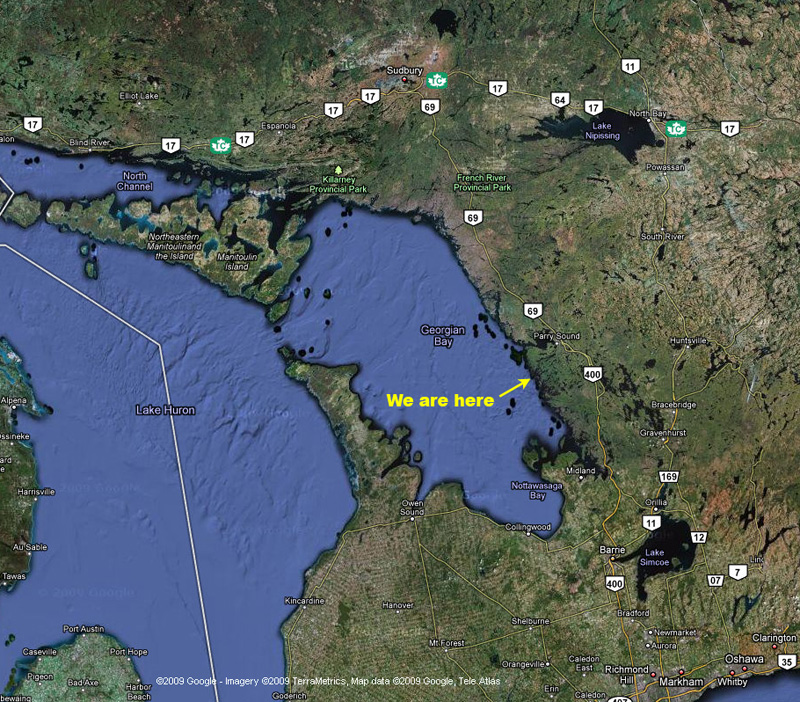
Is Georgian Bay
a "bay" or a "lake"?
From Wikipedia.
A bay is an area
of water mostly surrounded or otherwise demarcated by land. Bays generally
have calmer waters than the surrounding sea, due to the surrounding land
blocking some waves
and often reducing winds.
It can also be an inlet in a lake or pond. A large bay may be called a gulf,
a sea, a sound,
or a bight.
A narrow bay may also be called a fjord
if its sides are relatively steep. A cove
is a circular or oval
coastal inlet
with a narrow entrance; some coves may be referred to as bays. Most small
bays are formed as soft rock or clay is eroded by waves. Any hard rock is
eroded less quickly, leaving headlands.
Any bay may contain fish
and other sea creatures or be adjacent to other bays (for example, James
Bay is adjacent to Hudson
Bay). Large bays, such as the Bay
of Bengal and the Hudson
Bay, have varied marine geology. There are various ways that bays can be
created. For example, the water level of a sea can rise, flooding the shore
and creating a bay.
From Wikipedia.
A lake (Old English lacu) is a terrain
feature (or physical
feature), a body of liquid
on the surface of a world that is localized to the bottom of basin
(another type of landform or terrain feature; that is, it is not global).
Another definition is a body of fresh or salt water of considerable size
that is surrounded by land. On Earth a body of water is considered a lake
when it is inland, not part of the ocean,
is larger and deeper than a pond.
Natural lakes on Earth are generally
found in mountainous areas, rift
zones, and areas with ongoing or recent glaciation.
Other lakes are found in endorheic
basins or along the courses of mature rivers. In some parts of
the world there are many lakes because of chaotic drainage patterns left
over from the last Ice
Age. All lakes are temporary over geologic time scales, as they
will slowly fill in with sediments or spill out of the basin containing
them.
Well for my two cents worth, its a lake, its a bay in name
only.
|